
Greater Perth Unemployment Rises to 4.3%: What It Means for SMEs
Greater Perth’s unemployment rate was 4.3% in September 2026. See WA unemployment rates and why hiring remains difficult for SMEs.
 Pia Opena

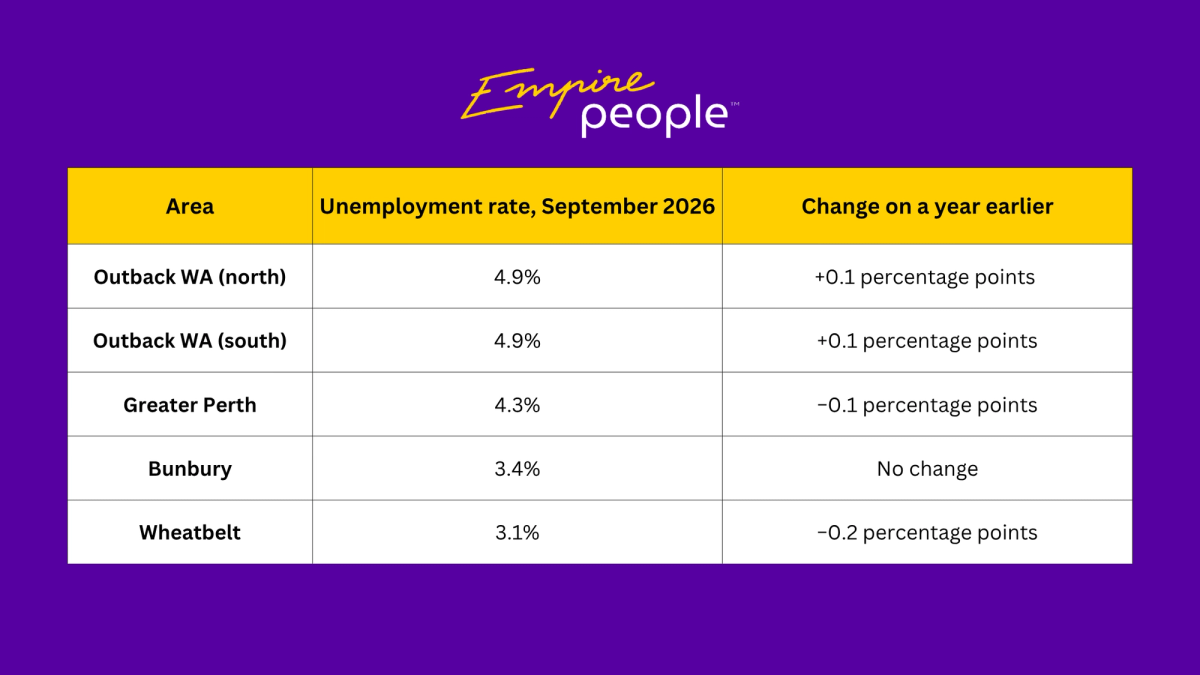
Greater Perth’s unemployment rate was 4.3% in September 2026, according to the Australian Bureau of Statistics (ABS) modelled estimates. It was 0.1 percentage points lower than a year earlier, but it remained higher than Western Australia’s overall rate of 4.2%.
This is a challenging market for small and medium-sized enterprises (SMEs) and is already becoming a major liability. Quality candidates are a lot harder to secure, hiring timelines are stretching out, and on top of that, the salary expectations keep climbing.
Key Takeaways
- Greater Perth's 4.3% unemployment rate keeps the local talent market tight for small businesses.
- Application volume often masks candidate quality, creating recruitment delays and skills mismatch issues.
- Candidates increasingly prioritise flexibility, competitive salary offers, and psychological safety.
- AI candidate screening speeds up recruitment but requires oversight to avoid risks around accuracy, bias, and candidate quality.
Western Australia's September 2026 Unemployment Rates
The table below shows ABS modelled unemployment estimates for Western Australia as of September 2026. Greater Perth had the second-highest rate, while the Wheatbelt had the lowest.
Why Finding Talent is Getting Harder for Greater Perth SMEs
Greater Perth’s 4.3% unemployment rate suggests there are people looking for work, but it does not mean SMEs can easily find candidates with the right skills, experience and availability. Many employers are still recruiting primarily to replace departing staff, while skills shortages continue to make some vacancies slower and harder to fill.
Skills Mismatch
A skills mismatch occurs when the people available to hire do not have the qualifications, technical capability, licences, or industry experience a role requires.
Job and Skills Australia found employers recruiting for higher-skilled roles most commonly cited the following barriers between 2021 and 2025:
- Lack of suitable applicants: Cited by 38% of employers with recruitment difficulty
- Lack of applicants overall: Cited by 27% of employers.
- Shortage of technically skilled candidates: Cited by 21% of employers.
Application Overload
More applications do not always mean better hiring options. Employers can receive a high volume of applications from people who are not qualified, available, locally based, or genuinely interested in the role.
In fact, recruitment difficulty remained high nationally in 2026, with 45% of employers reporting difficulty recruiting in the April 2026 survey, as reported by Business News.
Candidate Behaviour Changes
Many job seekers have started behaving differently, especially after the pandemic. They have shifted from looking for just a payslip to aggressively prioritising flexibility, autonomy, and psychological safety.
Economic Uncertainty
Economic uncertainty can make both employers and candidates more cautious. Businesses may delay permanent hires, reduce headcount plans, or prioritise replacement hiring over expansion, while candidates may be reluctant to change roles without confidence in job security, income stability, or career progression.
AI Screening Reliance
AI doesn't just make things more efficient for SMEs, but it also changes how you can better screen candidates in your hiring process. Gartner reported that 86% of organisations are adopting AI in their hiring processes. However, heavy reliance can create significant risks around accuracy, bias, and candidate quality.
Pros of AI Screening
- Scan hundreds of resumes in seconds
- Source and match qualifications against job descriptions much faster
- Removes the burden of scheduling interviews manually
- Reduce time-to-hire
Cons of AI Screening
- Fails to recognise transferable skills
- Struggles to evaluate unconventional backgrounds
- Often misses the context
- Jobseekers often feel alienated
Frequently Asked Questions
What is the unemployment figure for Perth this month?
The unemployment rate for Western Australia is 4.2% (as of September 2026), while the national Australian unemployment rate is 4.7%.
How does Perth’s unemployment rate compare to the rest of Australia?
Greater Perth’s 4.3% unemployment rate was lower than Australia’s 4.7% rate in September 2026. It was also slightly higher than Western Australia’s statewide rate of 4.2%.
Find the Right Talent
You need to move away from traditional recruitment methods to stay competitive. With Empire People, we can help you simplify managing your people by connecting you with the right technology and talent solutions to build, engage, and retain high-performing teams. Our data-driven hiring process uses psychometric testing and role profiling to find the right cultural and skill fit.
Get your free Black Friday playbook, or book a call to speak with our concierge team today about our all-in-one cloud HR and payroll platform.
Related Reading: