
What HR Metrics Every Australian SME Should Track in 2026
Learn the five essential HR metrics for Australian SMEs in 2026, including recruitment costs, turnover rates, and wage-to-sales ratios.
 Life Ocampo
Australian small-to-medium enterprises (SMEs) must track human resources (HR) metrics across five core pillars: recruitment, employee engagement, retention, performance management, and training and development.
According to the Council of Small Business Organisations Australia (COSBOA), SMEs face tightening operating margins as they absorb the impact of the Fair Work Commission's (FWC) 4.75% increase to modern award minimum wages (with a 6% bump to the National Minimum Wage), which took effect on 1 July 2026 alongside the legislated rise in the Superannuation Guarantee.
Furthermore, the newly introduced Payday Super framework requires employers to pay superannuation contributions simultaneously with regular wage runs, making real-time cashflow management critical.
Tracking these HR metrics helps business owners and HR managers make timely trade-offs between labour cost and revenue, optimise recruitment spend, and build targeted retention and development plans that protect margins and improve customer delivery.
Key Takeaways from Empire People
- Audit recruitment spend quarterly to ensure your cost-per-hire yields high-performing, long-term talent.
- Measure eNPS biannually to catch early signs of burnout before valuable employees resign.
- Monitor your wage-to-sales ratio monthly to protect profit margins from rising operational costs and tighter superannuation payment timelines.
Why Should You Track HR Metrics?
Tracking HR metrics allows you to understand where your direction is headed. Without these insights, small business owners risk overstaffing, underpaying key talent, or missing early signs of workplace burnout and toxic cultural shifts until valuable employees resign.
To get started, pull payroll, recruitment, and employee lifecycle data from your existing software (such as Xero, Employment Hero, or your Applicant Tracking System) once a month. Use this data to build a simple dashboard to review alongside your monthly profit and loss (P&L) statements.
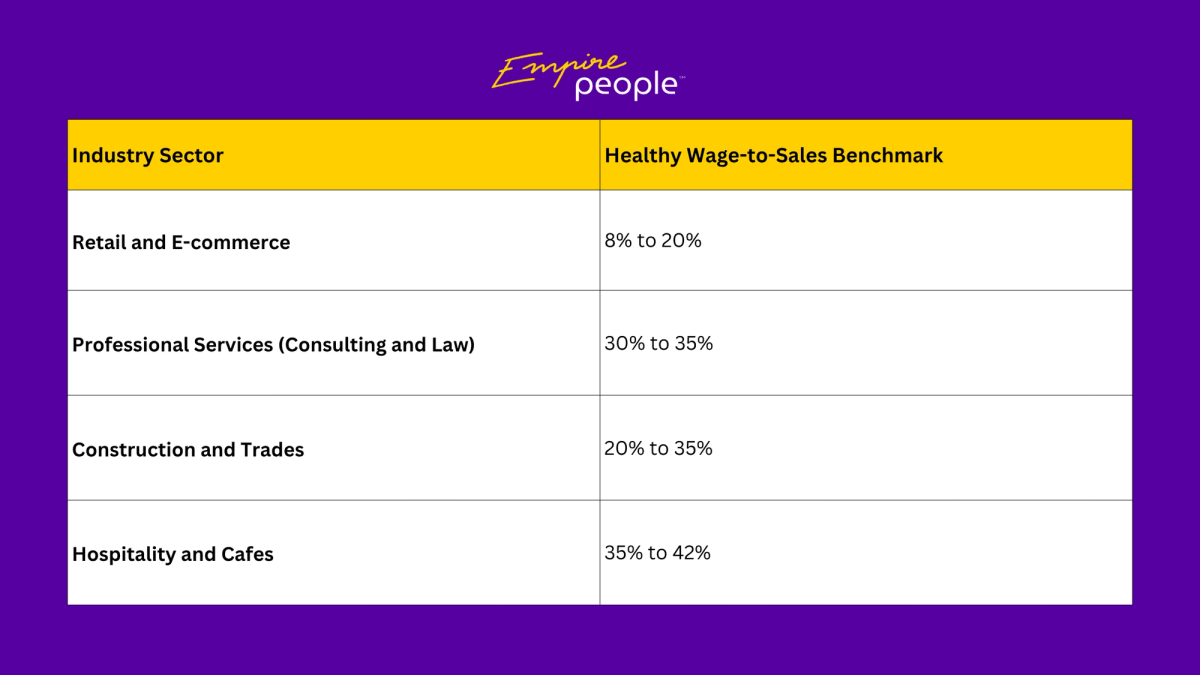
What is the Wage-to-Sales Ratio Benchmark for Australian SMEs?
The wage-to-sales ratio (also known as the labour cost ratio) measures your total payroll costs against your total revenue. Tracking this metric helps keep labour costs from consuming your profit margins, which is especially critical given high Australian compliance costs, superannuation increases, and award rates.
5 Essential HR Metrics to Track and Prioritise
1. Recruitment Metrics
Recruitment metrics measure the financial cost and operational speed of attracting, vetting, and hiring new talent into your business. By tracking cost-per-hire and time-to-fill, you can identify which job boards or agencies deliver the best value.
To get an accurate figure, you must combine both internal recruitment costs (e.g., staff time, internal referral bonuses) and external recruitment costs (e.g., agency fees, job board postings, candidate travel expenses).
The formula is:
Cost-Per-Hire = (Internal Recruitment Costs + External Recruitment Costs) ÷ Total Number of Hires
2. Employee Engagement Metrics
Employee engagement metrics measure how motivated, aligned, and emotionally committed your employees are to your business. The gold standard for tracking this is the Employee Net Promoter Score (eNPS), which assesses how likely your team is to recommend your business as a great place to work.
The formula is:
eNPS = % of Promoters (score 9-10) - % of Detractors (score 0-6)
3. Retention Metrics
Retention metrics track your ability to keep valuable employees over time, helping you identify if you are losing valuable talent too quickly. Your Annual Employee Turnover Rate measures the percentage of your workforce that leaves your organisation within a 12-month window.
The formula is:
Employee Turnover Rate (%) = (Total Departures ÷ Average Number of Employees) x 100
4. Performance Management Metrics
The most effective macro metric for an SME is revenue-per-FTE (full-time equivalent), which measures how efficiently your workforce is generating revenue.
The formula is:
Revenue-per-FTE = Total Annual Revenue ÷ Total Number of Full-Time Equivalent (FTE) Employees
5. Training and Development Metrics
Training and development metrics evaluate the return on investment (ROI) of the programs you run to upskill your workforce. They help ensure your development budget directly contributes to business growth and employee performance.
The formula is:
Training ROI (%) = [(Financial Benefit of Training - Total Cost of Training) ÷ Total Cost of Training] x 100
Frequently Asked Questions
What is the difference between HR metrics and HR KPI?
HR metrics are quantitative measures used to track and analyse workforce data (e.g., turnover rate or cost-per-hire). HR KPIs (Key Performance Indicators) are specific, strategic targets tied directly to broader business objectives (e.g., reducing voluntary turnover by 5% by Q4).
Put simply, all KPIs are metrics, but not all metrics are KPIs; metrics provide the raw data, while KPIs measure success against your most critical business goals.
Do ATO small business benchmarks include superannuation in labour calculations?
No, the Australian Taxation Office (ATO) excludes superannuation from its specific labour-to-turnover benchmark ratio calculation. The direct labour benchmark is calculated using salary, wages, and contractor payments (excluding payments to associated parties).
Simplify People Management with Empire People
Tracking these HR metrics gives Australian SMEs a practical line of sight to people-related management that protects your profit margins and supports your team.
Download the New Hire Checklist for Managers from Empire People to help your business succeed.