
HRIS vs Spreadsheet: Why Most Australian SMBs Outgrow Spreadsheets for HR
Only 23% of Australian employers have a centralised platform across HR. Learn why Aussie SMBs are making the switch to modern HRIS.
 Stephanie Manda

A human resources information system (HRIS) is a centralised software system that stores employee information and automates HR processes, while a spreadsheet is a manually maintained file with limited controls and workflow capability.
The 2026 ELMO HR Industry Benchmark Report found that filling a vacant role takes five days longer and new hires require 29% longer to reach productivity in Australia, showing how spreadsheet-based onboarding stalls time-to-value.
So, if you're still managing employee records, leave requests, and onboarding in spreadsheets, you might be holding your business back.
Key Takeaways
- Centralise employee records in an HRIS to eliminate data silos and manual entry errors.
- Automate onboarding to reduce hiring delays and improve new hire time-to-productivity.
- Mitigate Fair Work and STP Phase 2 compliance risks with automated award tracking.
What Is an HRIS?
In plain terms, an HRIS is one connected platform that keeps all your employee data in one secure place. It centralises employee information and supports recurring human resources processes including:
- Employee Database: Stores personal details, job history, compensation, and contact information.
- Payroll and Benefits: Automates salary calculations, tax deductions, and health or retirement benefit enrollments.
- Time and Attendance: Tracks work hours, paid time off, leave requests, and overtime.
- Recruiting and Onboarding: Manages job postings, applicant tracking, and new hire paperwork.
- Self-Service Portals: Allows employees to update their own personal information and view pay stubs.
Modern HRIS systems like Employment Hero often automate workflows, and it’s our recommended software for EmpireOne members seeking end-to-end HR and payroll automation.
Why Only 23% of Australian Employers Have a Centralised Platform Across HR
Only 23% of Australian employers have a fully centralised platform across HR, payroll and workforce management, according to ELMO 2026 HR Industry Benchmark report. The same source reports that 32% of employers still rely on manual processes to gather HR metrics.
When you continue to rely on fragmented systems and manual processes, it can lead to:
- Data silos: Employee information scattered across multiple files and systems.
- Compliance risks: Manual tracking of legislative changes and award interpretations.
- Inefficient reporting: Time-consuming data aggregation from multiple sources.
- Limited scalability: Systems that can't grow with the business
HRIS vs Spreadsheet: Side-by-Side Comparison
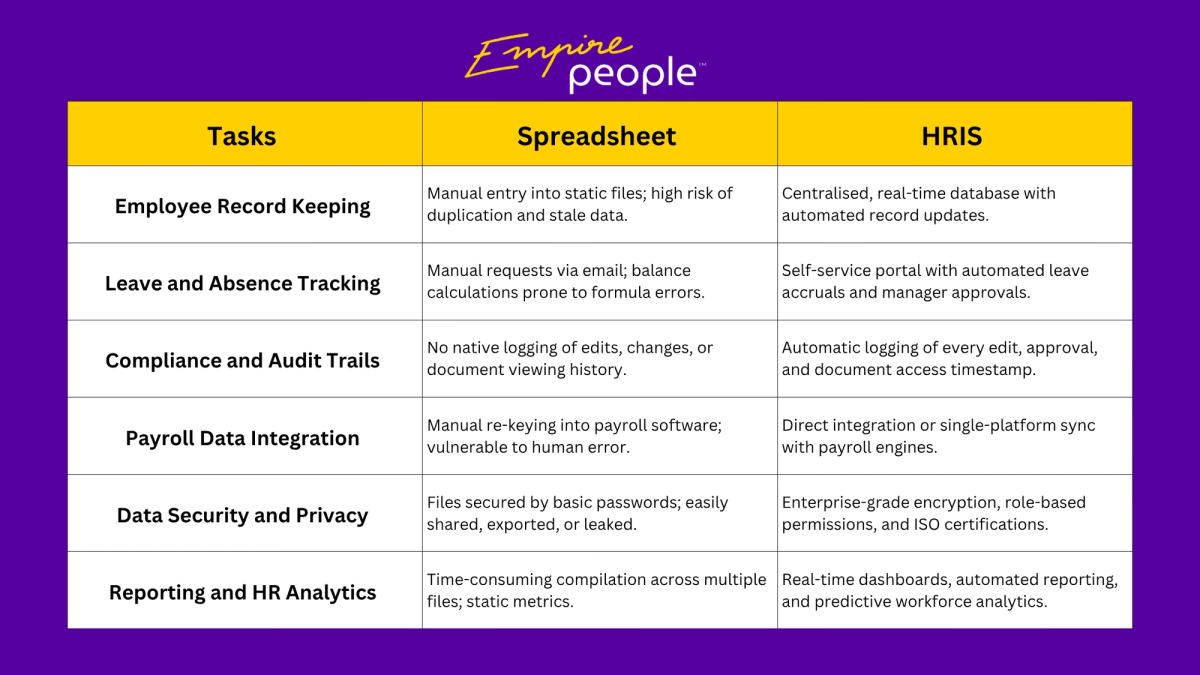
4 Signs Your Australian Business Has Outgrown HR Spreadsheets
1. Your HR Processes Are Scattered Across Multiple Files
If you're managing employee records in one spreadsheet, leave tracking in another, and onboarding documents in a third folder, you've outgrown spreadsheets.
This fragmentation leads to:
- Duplicate Data Entry: Updating details in one file requires manual updates across all others.
- Inconsistent Records: Conflicting information between files creates version control issues.
- Lost Time: Finding up-to-date employee records requires searching across fragmented folders
2. You're Still Manually Updating Employee Records and Payroll Information
Australian employers operate under strict Fair Work Ombudsman regulations, Modern Awards, and Single Touch Payroll (STP) Phase 2 rules. Manual data entry in spreadsheets inherently introduces:
- Human Error: Re-keying rates, hours, or leave balances manually leads to underpayments or incorrect accruals (which carry significant legal penalties under Fair Work wage compliance rules).
- Compliance Risks: Spreadsheets cannot automatically update for indexation, minimum wage changes, superannuation rate increases, or award updates.
- Data Discrepancies: A modern HRIS updates employee information across leave, onboarding, and payroll simultaneously from a single source of truth.
3. You're Taking More Time on Leave Tracking, Onboarding, and Document Management
Manual follow-ups for leave requests, onboarding setups, and document tracking waste valuable administrative capacity.
- Manual Chasing: HR teams spend hours following up on unsigned contracts and policy documents.
- Onboarding Bottlenecks: Manual workflows delay candidate setup and time-to-productivity.
- Employee Self-Service Solution: An HRIS enables staff to request leave, access payslips, and complete onboarding via self-service portals.
4. You're Extracting HR Reports from Multiple Files
If you're pulling data from multiple spreadsheets and spending hours consolidating information, your current system slows down your growth. Generating workforce reports should always be straightforward.
- Complex Aggregation: Pulling headcount or turnover data requires manual compilation and formula checks.
- Outdated Analytics: By the time spreadsheet reports are built, the data is already stale.
- Centralised Reporting: Modern HRIS platforms generate real-time dashboards and analytics from a single database.
Frequently Asked Questions
Is HR software worth it for a small team?
Yes! HR software is worth it for a small team once managing leave, onboarding, and records takes more than a few hours a week or causes manual errors.
Can I track my employees' leave in Google Sheets?
Technically yes, but it is highly risky. Google Sheets lacks automated leave accrual logic and Fair Work award compliance rules. Managing leave manually in spreadsheets frequently leads to calculation errors, version control conflicts, and potential privacy breaches under Australian privacy laws.
When should a small business move from spreadsheets to HRIS?
A small business should move to an HRIS when it reaches 10–15 employees, starts hiring rapidly, or notices frequent administrative errors in leave and payroll tracking.
Other key triggers include expanding across multiple locations, taking too long to onboard new staff, or needing to ensure strict compliance with modern awards and national employment standards.
Make the Switch
Most small businesses start with spreadsheets because it works, it does the job, until they don’t. Manual reports, endless formula-checking, and rewriting data are too time-consuming, and at some point you might start asking: Is it time to make a switch to an HRIS?
Empire People delivers complete HR, payroll and talent solutions for EmpireOne members, including an all-in-one cloud platform for payroll processing, compliance, leave management, onboarding, and employee records.
Book an HR consultation to talk through our complete suite of HR solutions today. We handle the people so you can focus on growth!